Category Archives: News

News

Updated: Reauthorization of the Substance Use Prevention, Treatment, and Recovery Services (SUPTRS) Block Grant

Today, NASADAD is releasing an updated fact sheet on the reauthorization of the Substance Use Prevention, Treatment, and Recovery Services (SUPTRS) Block Grant (formerly the Substance Abuse Prevention and Treatment [SAPT] Block Grant), housed within the Substance Abuse and Mental Health Services Administration (SAMHSA).

On December 29, 2022, President Joe Biden signed the Consolidated Appropriations Act, 2023 (H.R. 2617) now Public Law No: 117-164. This large omnibus bill included fiscal year 2023 appropriations and provisions reauthorizing certain federal programs through fiscal year 2027, including the SUPTRS Block Grant. The reauthorization of the Block Grant included new reporting requirements, language changes, and more.

To see a side-by-side analysis of the Public Law compared to the legislation proposed in the House of Representatives and Senate, check out this new fact sheet.

Download (PDF, Unknown)

An Overview of the Synar Provision: History, Impact of Tobacco 21 Legislation, and Recommendations

This updated factsheet includes the federal revisions to guidance that occurred between 2020-2022 as a result of the COVID-19 pandemic.

Congress enacted the Alcohol, Drug Abuse, and Mental Administration Reorganization Act (Public Law No: 102-321) in 1992 that included a provision referred to as the Synar Amendment. The Amendment aims to decrease youth tobacco use by requiring States and Territories to enact and enforce laws prohibiting the sale or distribution of tobacco products to individuals under the age of 18.

In 1996, the Substance Abuse and Mental Health Services Administration (SAMHSA), within the Department of Health and Human Services (HHS) issued a regulation giving further guidance to States related to Synar implementation and enforcement. The regulation required States to conduct annual, unannounced inspections of tobacco retailers that provide a probability sample of the accessibility of tobacco products to minors under the age of 18. States had to meet at least an 80 percent compliance rate of retailers refusing tobacco sales to minors. States that have a retail violation rate of more than 20 percent resulted in penalization of up to 40 percent of a State’s Substance Use Prevention, Treatment, and Recovery Services (SUPTRS) Block Grant (previously named the Substance Abuse Prevention and Treatment [SAPT] Block Grant).

Over time, Congress worked with the Administration to offer an alternative penalty that was significantly less that the 40 percent marker but required the State to generate funds to remedy the violation. No federal funding was ever provided to the managers of the Substance Use Prevention, Treatment, and Recovery Services (SUPTRS) Block Grant – State alcohol and drug agencies – to specifically support Synar implementation and enforcement activities.

For questions or more information, please contact Lacy Adams (ladams@nasadad.org).  

Download (PDF, 225KB)

TECHNICAL BRIEF: CENSUS OF OPIOID TREATMENT PROGRAMS

In order to capture current patient census data for people being treated for opioid use disorder in OTPs, the National Association of State Alcohol and Drug Abuse Directors (NASADAD) in partnership with the American Association for the Treatment of Opioid Dependence (AATOD), developed a census survey of all patients enrolled in treatment as of January 1, 2021, in Substance Abuse and Mental Health Service Administration (SAMHSA) certified OTPs in the United States (U.S.). The project was supported by the SAMHSA-funded Opioid Response Network (ORN).

The purpose of the survey was to determine the number of patients receiving medications for opioid use disorders (MOUD) in OTPs, the types of federally approved medications being used by patients in treatment, and the specific formulations of medication used among the patient population.

This is the first time that such information is being made available to federal and state agencies that have jurisdiction in this area in addition to the general public.

At the time of the census, 1,826 OTPs were listed in the SAMHSA OTP directory. A total of 1,547 OTPs across the country completed the census survey, reflecting an 85% response rate. The full report indicates the medication breakdown for 512,224 patients. Of the 512,224 patients in OTPs who reported using MOUDs, 476,763 reported using methadone, 33,473 reported buprenorphine, and the remaining 1,988 reported using naltrexone. In addition to the most common MOUDs being used, the census captured formulation data from 510,557 patients including the most common formulation types, the number of patients using each formulation, and regional differences between formulation use.

Through this census, NASADAD and AATOD have captured crucial and actionable data to better understand treatment demand and demand for specific medications in OTPs. This report lays important groundwork to examine future demand and service issues in OTPs.

Download (PDF, 3.1MB)

Contact:

Melanie Whitter
Deputy Executive Director and Director, Research and Program Applications
National Association of State Alcohol and Drug Abuse Directors, Inc.
mwhitter@nasadad.org
(202) 292-4873

Mark W. Parrino
President
American Association for the Treatment of Opioid Dependence (AATOD)
mark.parrino@aatod.org
(212) 566-5555 Ext: 200
Reauthorization of the State Opioid Response (SOR) Grant Program

The State Opioid Response (SOR) grant program, housed within the Substance Abuse and Mental Health Services (SAMHSA), is a federal grant program designed to address the “opioid overdose crisis by providing resources to states and territories for increasing access to FDA-approved medications for the treatment of opioid use disorder (MOUD), and for supporting the continuum of prevention, harm reduction, treatment, and recovery support services for opioid use disorder (OUD) and other concurrent substance use disorders (SAMHSA, 2022).”

The National Association of State Alcohol and Drug Abuse Directors (NASADAD) serves as the voice of State alcohol and drug agencies in Washington, D.C. NASADAD’s members are the State Single Agencies (SSAs) responsible for applying, receiving, and distributing SOR funds to programs and providers. The SOR  grant program is currently up for reauthorization. As a result, NASADAD has developed an overview of key provisions in legislation in the the House of Representatives and Senate to reauthorize the program.

For more information about how States are using SOR funds, please visit the IMPACT OF STATE TARGETED RESPONSE & STATE OPIOID RESPONSE GRANTS.

Download (PDF, 265KB)


This fact sheet is a “living document” and will continue to be updated as legislation progresses through Congress. Please reach out to Lacy Adams (Ladams@nasadad.org) with any questions.

Frequently Asked Questions (FAQs) About President Joe Biden’s Proclamation to Pardon Simple Marijuana Offenses

On October 6, 2022, President Joe Biden issued A Proclamation on Granting Pardon for the Offense of Simple Possession of Marijuana. The Proclamation set in motion a pathway to pardon all individuals with simple possession of marijuana offenses in violation of the Controlled Substances Act (U.S.C.844) or in violation of D.C. Code 48–904.01(d)(1). In response, NASADAD developed a fact sheet for State alcohol and drug agencies, Frequently Asked Questions (FAQs) About President Joe Biden’s Proclamation to Pardon Simple Marijuana Offenses, that explores answers to common questions around the timeline for pardons, what does receiving a presidential pardon entail, who does this proclamation apply to, and more.

Download (PDF, 211KB)

State Models for Addressing Opioid Use Disorders: Recovery Support in Integrated Care Settings – Brief and Webinar

Join the National Association of State Alcohol and Drug Abuse Directors and the Center of Excellence for Integrated Health Solutions (CoE-IHS) for a webinar on State Integrated Models: Hub and Spoke and Bridge Models, on Thursday, October 27, from 11:30 a.m. – 1:00 p.m. ET as we explore two states models that integrate recovery support services. Experts from the States of California and Tennessee will present their innovative CA Bridge Program and Tennessee Hub and Spoke Model. Read more about these integration approaches in our new issue brief, State Models for Addressing Opioid Use Disorders: Recovery Support in Integrated Care Settings.

Data indicates that nearly 75% of the nation’s 91,799 drug overdose deaths involved synthetic opioids, a shift that is consistent with trends indicating a worsening drug overdose epidemic. As the epidemic evolves, states have sought more effective solutions to reduce and treat opioid use disorders (OUD) and prevent overdose.

Integrated care models offer an effective solution; a research-based approach to manage chronic conditions like OUD, enhancing access to care and ensuring clients receive individualized services. OUD is a chronic relapsing condition that necessitates integrated forms of health and social service provisions to improve continuity of care.

Registration is available here.


Download (PDF, 1.92MB)

Interactive Map – Impact of State Targeted Response & State Opioid Response Grants

NASADAD has developed an interactive map showing the impact of State Targeted Response (STR) & State Opioid Response (STR) grants.

The Substance Abuse and Mental Health Services Administration (SAMHSA) previously funded the State Targeted Response to the Opioid Crisis (STR) grant and currently funds its successor, the State Opioid Response (SOR) grant, to address the opioid crisis.  SOR funding can be used to support evidence-based prevention, treatment, and recovery support services for opioid and stimulant misuse and use disorders.

To understand how grant recipients have used these funds, NASADAD developed state and territorial -specific briefs that describe highlights of each state alcohol and drug agency’s use of STR/SOR funds across the continuum of care.  Thematic briefs were also developed to analyze common strategies and services states have implemented for opioid and stimulant misuse and use disorders using STR/SOR funding.

On September 8, 2022, NASADAD hosted a virtual event including remarks from the Substance Abuse and Mental Health Services Administration (SAMHSA), Opioid Response Network (ORN), and Single State Agency (SSA) Directors, who presented on SOR-funded initiatives and shared their impact.

Presentations: 


Impact of State Targeted Response & State Opioid Response Grants

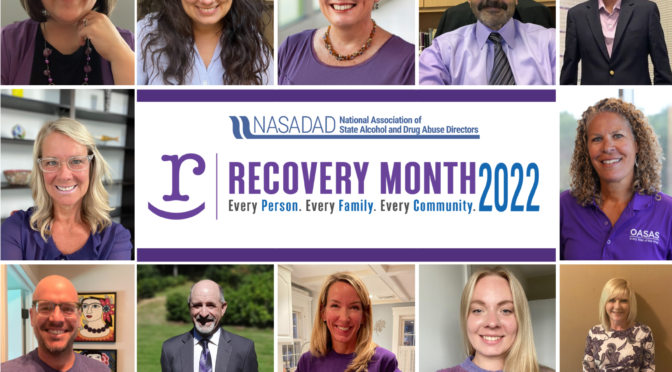
NASADAD Recognizes National Recovery Month

Substance use disorders affect all communities nationwide, with commitment and support, those impacted can embark on a journey of improved health and overall wellness. The focus of Recovery Month each September is to celebrate all people that make the journey of recovery possible by embracing the tagline, “Recovery is For Everyone: Every Person, Every Family, Every Community.” Recovery Month spreads the message that people can and do recover every day.

The impact of substance use disorders is apparent in States, and more than 100,000 died of a drug overdose in the 12-month period ending in March 2022. Through Recovery Month, people become more aware and able to recognize the signs of substance use disorders and co-occurring diseases and encourage people in need of recovery services to seek help. Managing the effects of these conditions helps individuals achieve healthy lifestyles, both physically, and emotionally. The Recovery Month observance continues to work to improve the lives of those affected by substance use disorders by raising awareness and educating communities about the effective services that are available.

NASADAD’s members serve as the lead agency in each State or jurisdiction responsible for managing federal funds dedicated to addressing substance use prevention, treatment, and recovery. This month, our Members wear purple to celebrate recovery and promote awareness of substance use disorder issues. NASADAD is grateful for the work all of our members do in their States and jurisdictions to support recovery every day of the year.


SAMHSA Events

September 7, 2022 – Recovery Rally Happens, Sacramento, CA

September 13, 2022 – National Opioid and Substance Awareness Day (NOSAD)

September 14, 2022 – Recovery Policy Scholars Visit SAMHSA

September 16, 2022 – National Recovery Agenda Preview and Panel Discussion

September 16, 2022 – Mobilize Recovery Bus Tour Across America

September 30, 2022 – Young Adults in Recovery – Making Small Choices, Every Day